Like the articles? Research is expensive and time is money. Help keep this site up and running. Please send your donation in Bitcoin or other supported cryptocurrencies to the addresses below:
The Bloomberg article stated that top executives of Google and Yahoo would not be attending Barack Obama’s Cybersecurity Summit at Stanford University (Feb. 13, 2015).
What I found interesting, though not addressed in the Bloomberg article, is that Google and Yahoo were both originally started as student projects at Stanford University.
Here’s some video footage of Obama speaking that the Cybersecurity Summit at Stanford University:
I believe that technology is an important theme or subject to consider when voting for US President and other elected government officials. For example, what are the candidate’s views, philosophies and positions on technology and what plans, if any, do to they have to implement, or suppress, technology?
Will government funded research into technology be used to advance killing machines (e.g., drones) or will it be used to advance renewable energy (and perhaps free energy)? Or will it be used for both?
Today is Sunday and we here at WOBIK want to keep things light on the first day of the week so we aren’t going to delve into presenting results of a probe into a Obama’s wide-ranging views and positions on technology.
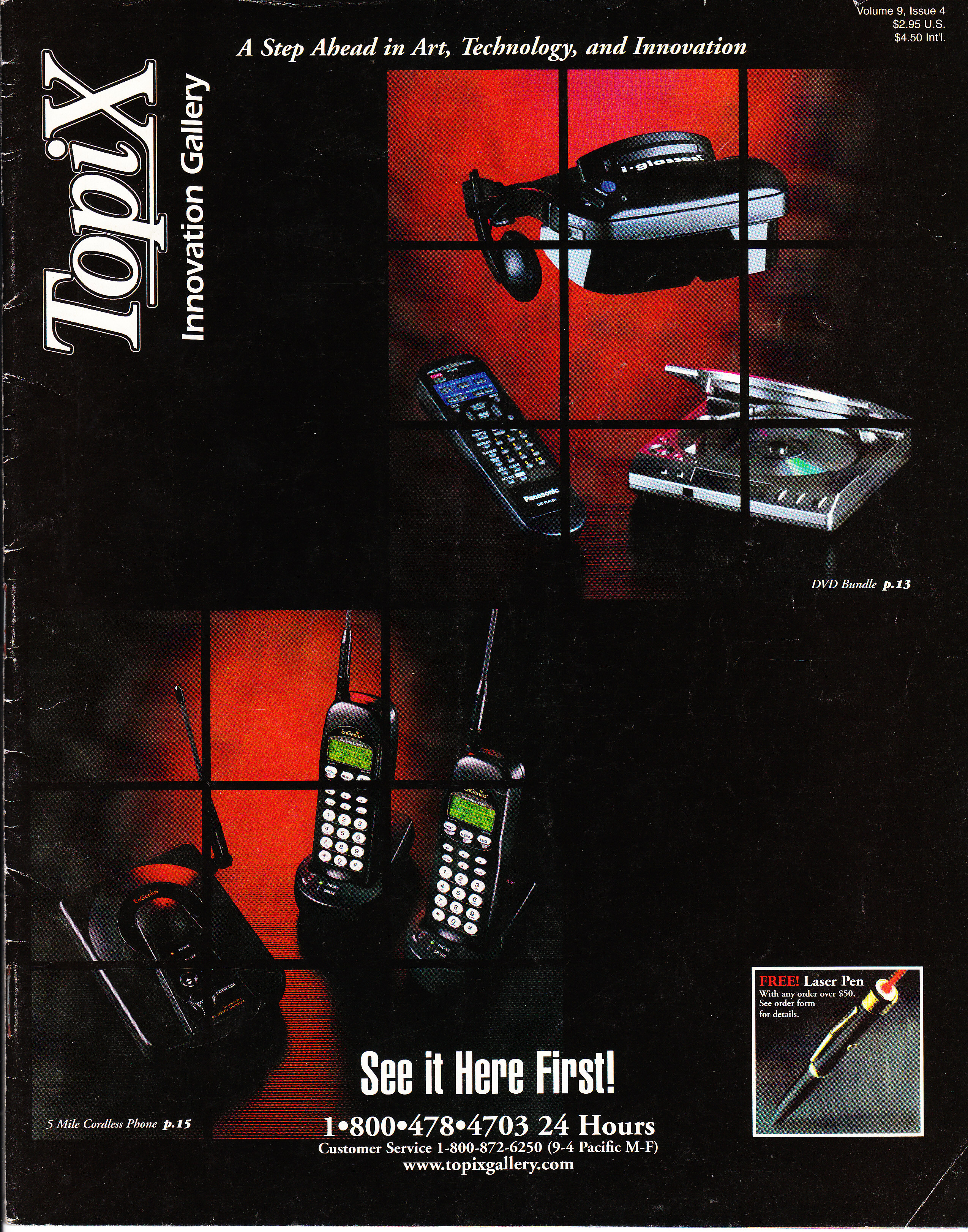
What we will present today (technology related) is a blast from the past: the lower half of page 13 (provided above) of a defunct magazine called Topix (or Topix Innovation Gallery). We’ve made some scans of the tangible magazine itself and page 13 proclaims that The Future Has Arrived!
This issue of Topix was published in the late 1990s (1998 or 1999?).
For sale is the I-glasses Display System and the I-glasses DVD System.
The listing states:
If someone was to tell you that you could view the latest blockbuster feature films in DVD digital clarity on a 52″ (52 inch) screen and full surround sound by simply donning a pair of goggles you would think they were crazy, right?
Well, thanks to the ultra-advanced technology of the I-glasses, the future of personal theater is now. When used with the portable DVD player, the I-glasses turn your head into the greatest home theater imaginable.
Picture yourself sitting on a plane with five long hours to go until you land. You have a choice, either crane your neck to watch a glimpse of the postage stamp sized screen showing the on-flight movie that you have no desire to see, or pop in a disc of your choice and watch a movie you want on what translates to a giant 52″ (52 inch) screen, and hear it through state of the art, fully adjustable surround-sound headphone speakers that will put you inside action and blow you away.
For the first time in history a portable entertainment unit has actually eclipsed the home version in quality. The I-glasses are 3D compatible, have settings for brightness, contrast, color, tint and can be connected to your VCR or TV for private, big screen viewing of your favorite shows, all at an incredible weight of only eight (8) ounces.
The package includes a custom carrying case and one 4.0 AH battery good for up to 3.5 hours of viewing. Unit also runs on a regular AC current.
Take advantage of this breakthrough and put a movie palace in your pocket. Oh and you may want to pick up the optional extra pair of I-glasses that allows two (2) people to view at the same time – otherwise, if you let someone try them out, you may never get them back!
Prices tags
I-glasses DVD Bundle – $1,499.95
I-glases Display System (Glasses only) – $599.95
Here’s a scan of the front cover of the now defunct Topix magazine:
Here’s a scan of the upper back cover of the now defunct Topix magazine:
Please exercise your free speech in the comments section below. There are no stipulations of political correctness on this blog. Speak your mind, give us your thoughts, both objective and subjective. Share your ideas, hunches, inklings or your expertise. Please provide recommendation and corrections if you spot errors in fact within the blog report. Lastly, remember that posting a comment is much like casting a vote, so please do so.
On its 10’clock news Feb. 13, 2015, Fox 5 San Diego, or KSWB-TV, briefly depicted President Obama as a suspect in a San Diego State University sex-assault case. His image appeared with “NO CHARGES” beside anchor Kathleen Bade. Mike Wille, a Fox 5 News assignment editor, said it was an accident.
Please exercise your free speech in the comments section below. There are no stipulations of political correctness on this blog. Speak your mind, give us your thoughts, both objective and subjective. Share your ideas, hunches, inklings or your expertise. Please provide recommendation and corrections if you spot errors in fact within the blog report. Lastly, remember that posting a comment is much like casting a vote, so please do so.
Director Orlando von Einsiedel has teamed up with Leonardo DiCaprio and Netflix to share Virunga with the entire world. The film was released November 7, 2014 on Netflix.
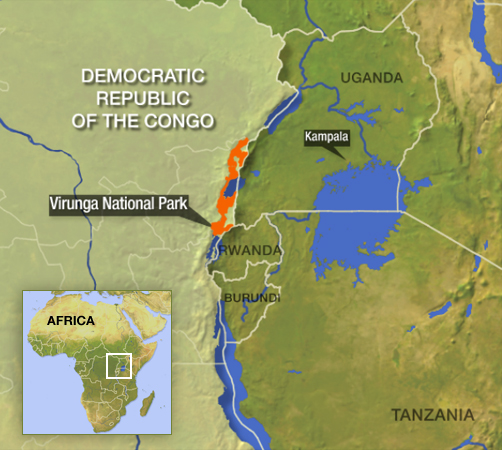
Mountain gorillas are found only in the Democratic Republic of the Congo and Uganda. In the Congo they live in the Virunga National Park (8 volcanoes: 6 dormant and 2 active) which borders the Uganda and Rwanda. In Uganda they live in the Bwindi Impenetrable National Park.
According to a survey/census conducted by the Ugandan Wildlife Authority the estimated population of the mountain gorillas is 880. The 2012 report indicates 400 in Uganda and incorporates a 2010 survey which counted 480 in the Congo.
At the outset of the Virunga documentary we are shown footage of a funeral service for Virunga National Park Ranger Kasereka Kipako (age 34) who was ambushed and murdered at his patrol post in 2013.
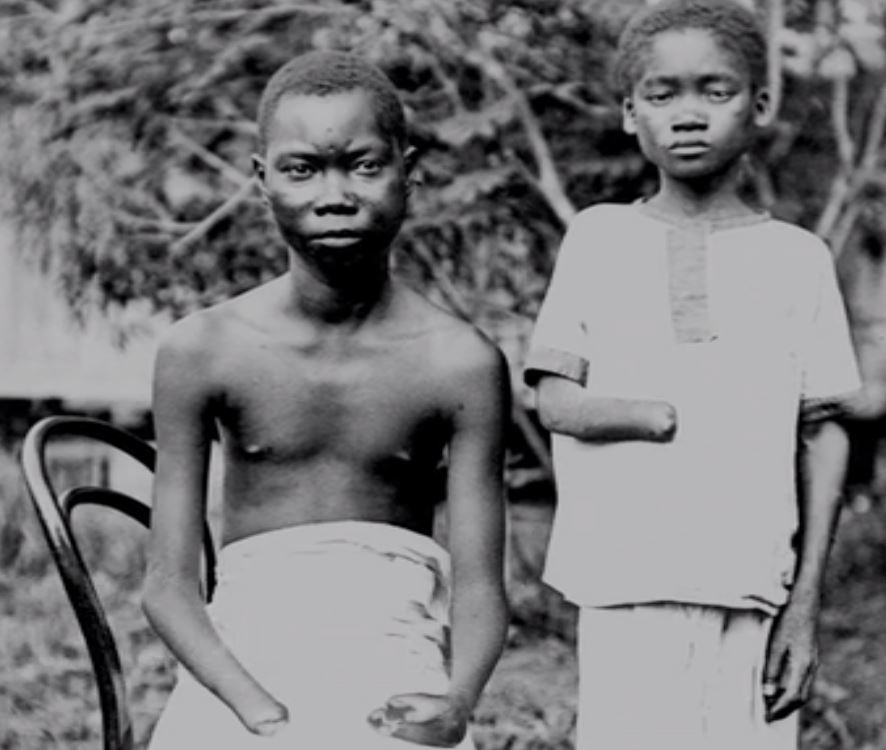
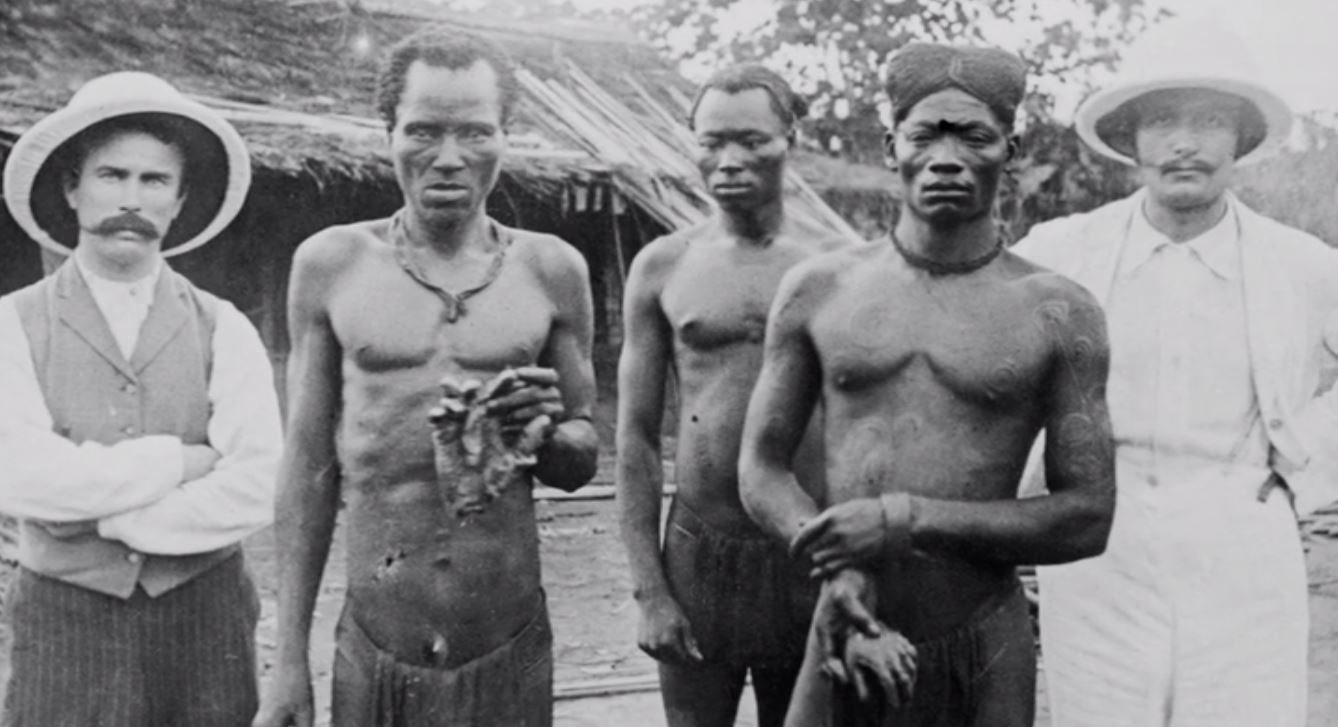
We are then presented with a brief summary of the history of colonial Congo (Congo Free State 1877–1908 and Belgian Congo 1908–1960) which is shown in photographs and video footage. These are accompanied by a song called We Will Not Go which was composed by J. Ralph and performed by Salif Keita, Fally Ipupa and Youssou Nddour.
Include in the intro is the policy implemented by the white Europeans of cutting off the hands innocent children and wives as punishment for their Congolese fathers/husbands not meeting the rubber collection quota:
We are also introduced to early post-colonial Congo (1960) and Patrice Lumumba – a Congolese independence leader and the first democratically elected Prime Minister of the post-colonial Congo. He was executed by firing squad on January 17, 1961 (at age 35) by United States & Belgian backed forces.
Some of the documentary takes place at a gorilla orphanage (the only one in the world) called Senkwekwe Center in Rumangabo which is located in the southern sector of Virunga National Park.
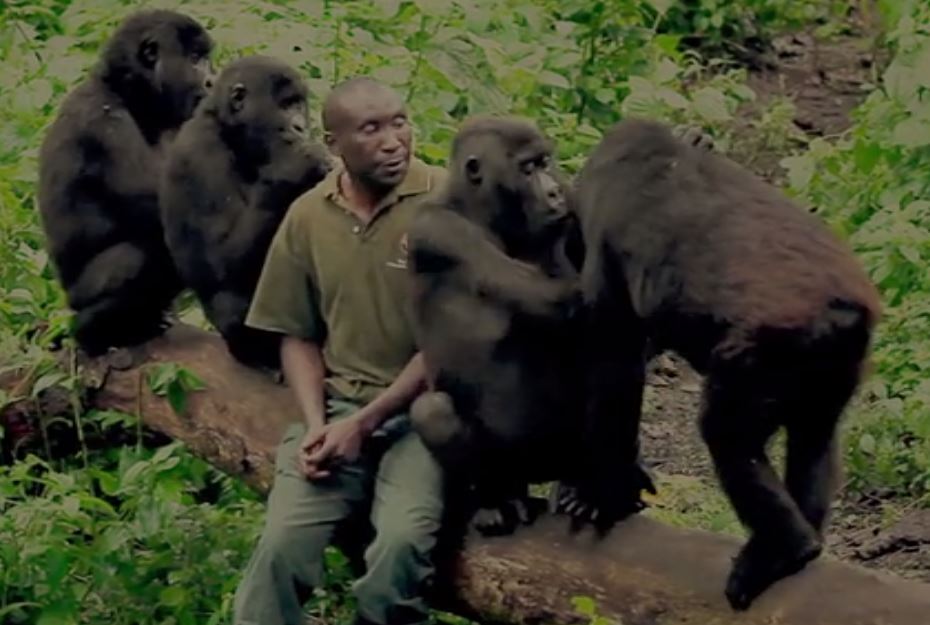
At the gorilla orphanage we meet Andre Bauma who is a gorilla caretaker. He appears to be a very likable guy and he has thoroughly dedicated his life to helping the mountain gorillas.
There are four (4) young mountain gorillas at the orphanage and the film indicated that are the mountain gorillas in captivity in the world.
Their names are:
Maisha: She was rescued at age 3. Poachers had killed her mother and father and were going to sell the baby (Maisha). Poachers typically kill the gorilla parents because they will fight to the death to protect their children.
Kaboko: He lost one of his hands to poachers.
Ndeze:One of the two survivor (young female) of a 2007 gorilla massacre.
Ndakasi: One of the two survivor (young female) of a 2007 gorilla massacre.
Here is a picture of gorilla caretaker Andre Bauma with the four young gorillas whom he considers to be part of his family:
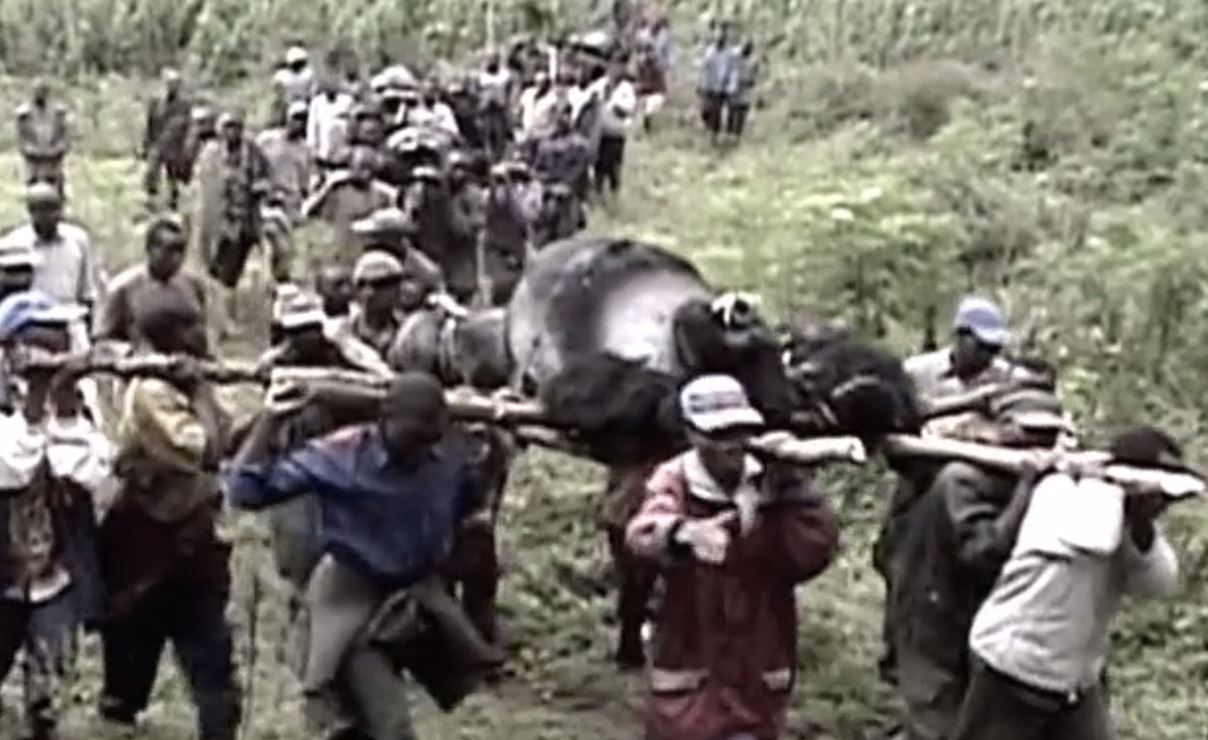
In 2007 a family of mountain gorillas were killed by poachers in hopes of discouraging the rangers into giving up efforts to protect Virunga National Park. Some of the immense mountain gorillas were so large and that it took what appears, at some points, to be at least thirteen (13) men to carry just one of them on an improvised stretcher.
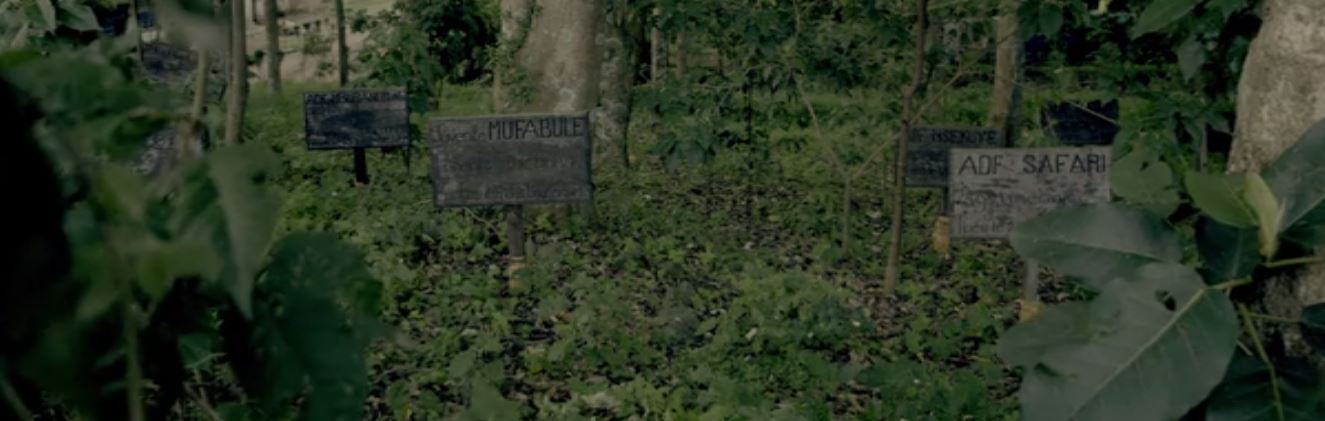
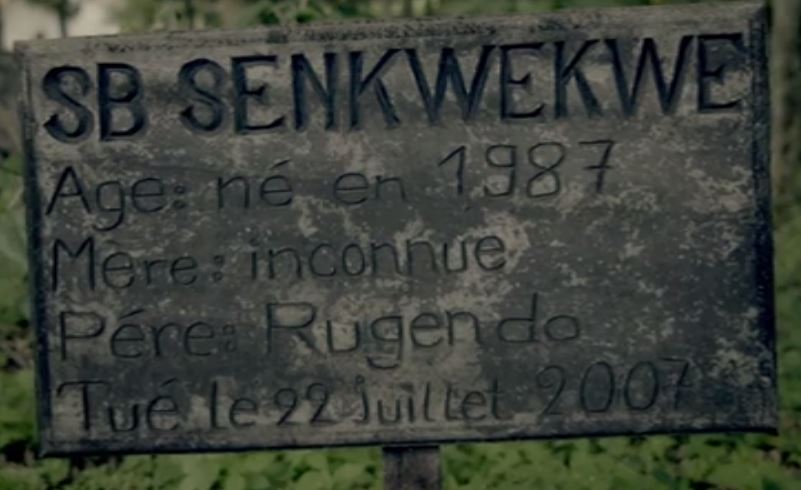
The mountain gorillas were given funerals and they rest in a cemetery complete with gravestones which bare their names, ages and dates of death:
Fast forward to 2010: Poachers are still problem but they are no longer the most substantial obstacle for the park rangers and nor the largest threat to the mountain gorillas. A British company called SOCO International plc began exploring for oil in the in Virunga National Park. Oil might be found within the park and a large percentage of it under Lake Edward.
The film indicates that 130 (or 140?) park rangers have died protecting Virunga National Park. However, I’ve read other interviews with Emmanuel de Merode in which he has explained that up until some point 1996 (or 1994?) the killing of park rangers was not documented. Many rangers were killed before 1996 (or 1994?) during the long history of Africa’s oldest national park.
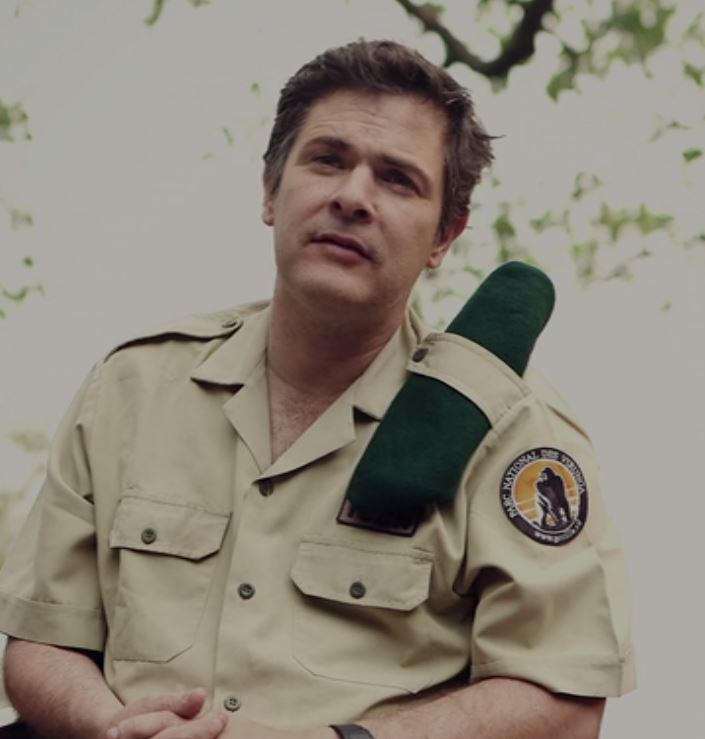
The Provincial Director of Virunga National Park is Emmanuel de Merode (adjacent picture).
He was born in north Africa (Carthage, Tunisia) and spent his childhood in Kenya.
He is legally a Belgian prince although he prefers to not use his hereditary title.
Apparently Princely House of Merode is one of the most important families of the Belgian nobility.
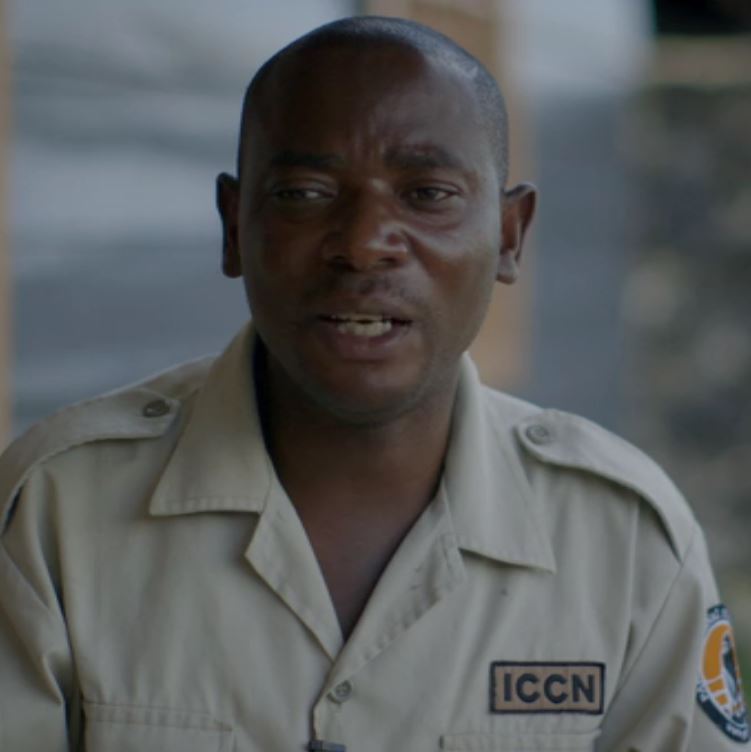
From what I can gather from the film, and other sources, Emmanuel de Merode and all of the other park rangers work for ICCN – Congolese Institute for Nature Conservation (Institut Congolais pour la Conservation de la Naturein French)
Their uniforms bare the acronym ICCN (Congolese Institute for Nature Conservation in English or ). They are law enforcement officers and work for the Congo government (this includes Andre Bauma the gorilla caretaker).
It appears that government management of ICCN is located in Kinsasha (the capitol of the Democratic Republic of the Congo) which is located approximately 1000 miles (by flight) away from Virunga Nation Park. If you were moving across land the distance would be far greater than 1000 miles.
Even though oil exploration is illegal in the park, and the fact that the park is listed as a World Heritage Site, it appears that SOCO International plcmanaged to pay off the government management of ICCN in Kinsasha.
Virunga National Park is listed as a UNESCO (United Nations Educational, Scientific and Cultural Organization) World Heritage Site. Under Congolese law and international law oil related activities are illegal.
When SOCO International announced their intentions to explore for oil the Provincial Director of Virunga National Park (Emmanuel de Merode) informed them that oil related activities are illegal at the park.
Soon thereafter SOCO International plc arrived in a convey of armed vehicles and forced their way into the park.
Keep in mind that all park rangers, including the Provincial Director, are armed with pistols, rifles, machine guns and shoulder-fired surface-to-air missiles.
Provincial Director of Virunga National Park (Emmanuel de Merode) formed a plan with the Warden of the Central Sector of Virunga National Park, Rodrigue Katembo (adjacent picture), to gather objective and tangible evidence and documentation of SOCO International’s plans to exploit oil from the Congo.
Rodrigue Katembo (Waden of the Central Sector of Virunga National Park) began an undercover investigation. He used small concealed video cameras (including a GoPro camera) to record face to face conversations with members of the Congolese Army, SOCO International plc employees, SOCO International plc subcontractors, SOCO International plc security and SOCO International plc supporters.
In the film you can see and hear SOCO International plc local supporters negotiating with Ranger Rodrigue Katembo and explaining that they are inline with SOCO International plc and that Emmanuel de Merode is the only person in the chain of authority of the park who is standing in way of SOCO International’s plan for big oil.
The local SOCO supporters explain that oil is worth billions and that Ranger Rodrigue Katembo will have some of that money too if he can help SOCO. The supporters state that everyone in the government (including the Minister of the Environment) in the capital (Kinsasha) have authorized SOCO and their oil plans. They state that they will arrange a meeting for Ranger Rodrigue Katembo with the Minister (Bavon N’sa Mputu Elima? Or Célestin Vunabandi Kanyamihigo?)
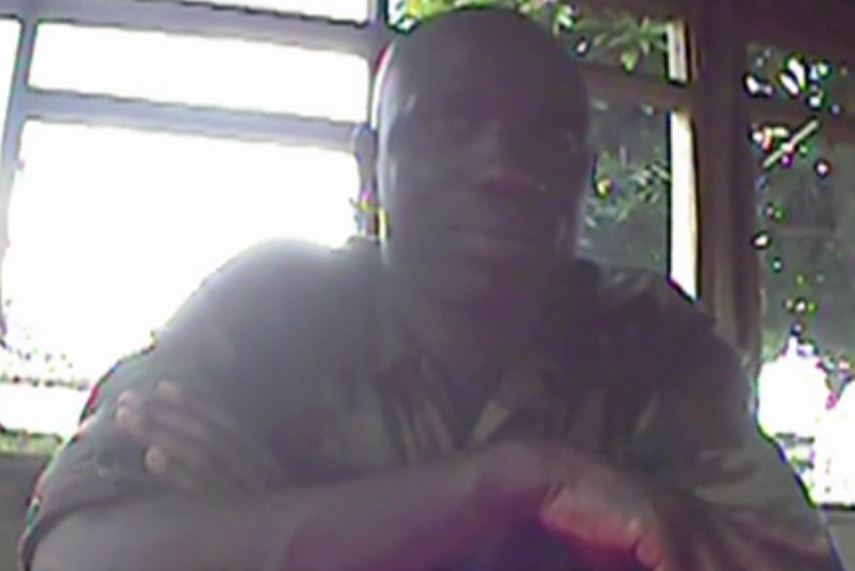
Ranger Rodrigue Katembo also captured video and audio of a captain in the Congolese Army (Captain Feruzi) stating that SOCO International needs him (Ranger Rodrigue Katembo) and that they will pay him $3000 dollars and also later when the oil is flowing that they will provide him with anything that he wants. Captain Feruzi states SOCO International wants Ranger Rodrigue Katembo to secretly feed them information on a regular schedule regarding the actions and plans of Emmanuel de Merode.
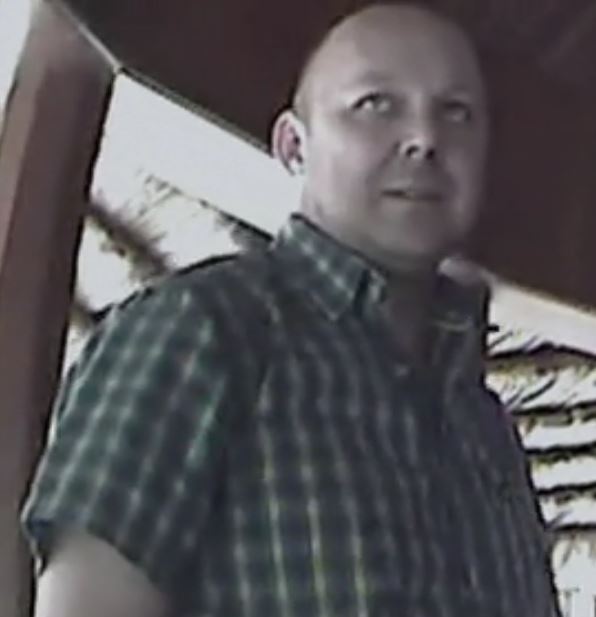
Ranger Rodrigue Katembo also captures video and audio footage of Pieter Wright (a white South African) – a SOCO security contractor (adjacent picture).
Pieter Wright explains to Ranger Rodrigue Katembo that SOCO will soon begin working in his area of the park and that they will be in contact with him (Ranger Rodrigue) soon.
Wright then passes Ranger Rodrigue a small amount of money. I’ve read elsewhere that it amounted to $50 dollars. This might not sound like much to an American but believe me it is a significant amount to an average working class Congolese citizen such as a park ranger. I’m not exactly sure how much money a park ranger earns in the Congo for his job but I know other people in the Congo who work as employees and earn about $10 dollars a month.
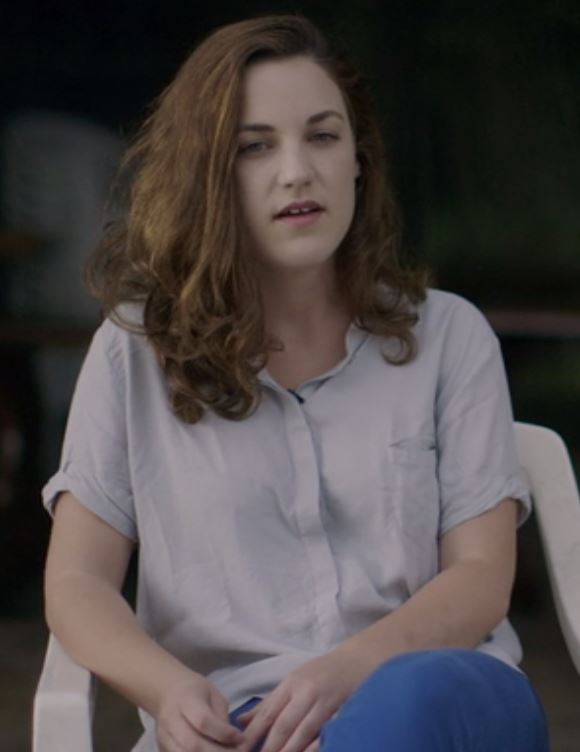
At almost thirty (30) minutes into the film we meet a young French freelance journalist (or war correspondent) who indicates that she has been living in Goma (a city adjacent to Virunga Nation Park), Congo for approximately one and a half years (I’m not sure at what point in time that she said that so I’m not sure exactly how long she’s now been in the Congo.)
There were twelve (12) armed rebel groups who operated (and most still do) in and around Virunga National Park (they all opposed the the Congolese Army). Melanie Gouby indicates that one rebel group, who call themselves M23 (March 23 Movement), started their conflict with Congolese Army at about the same time that SOCO International began exploring for oil in Virunga.
Melanie Gouby began to secretly video and audio record during her private meetings with SOCO International employees and members of the M23 rebel group.
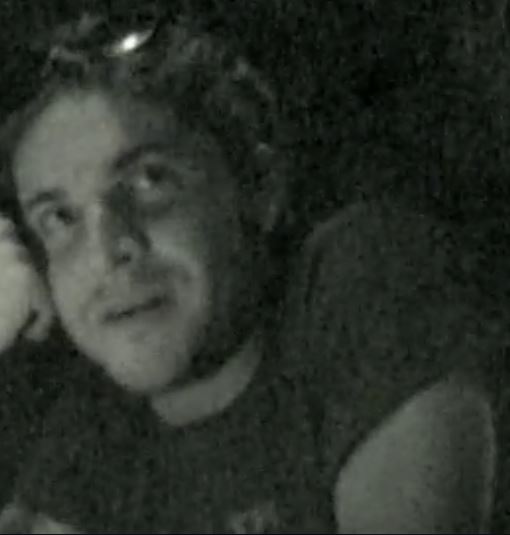
She met with Julien Lechenault – SOCO Internationl Fields Operation Supervisor in Goma (adjacent picture), on several occasions and secretly recorded video footage of the interviews.
At one of the meetings Julien Lechenault states that best solution for counties such as the Congo is to be recolonized by Europe. He states that their is no other solution and that Europe must manage countries such as the Congo. He states that the Congolese are like children and cannot manage themselves.
Julien Lechenault also states that the only person standing in SOCO International’s way of oil exploration is Emmanuel de Merode. He states that Emmanuel has all of the power in the park even though ICCN (Congolese Institute for Nature Conservation) management (in Kinsasha) has already given SOCO permission to explore for oil in the park.
At one of the recorded meetings Julien Lechenault arrived with two other individuals.
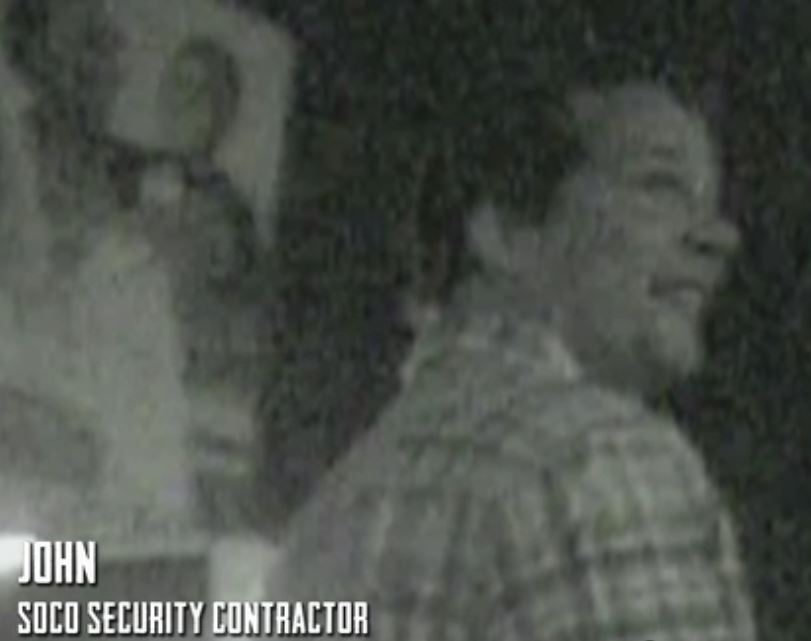
One was a SOCO Security Contractor named ‘John’ (British) who stated that he was a mercenary and apparently bragged about killing people and his life as a mercenary.
John admitted that SOCO paid the security contractors (he is one of them) to pay the rebels for protection.
Julien Lechenault indicated that SOCO doesn’t deal with the rebels but that SOCO’s security contractors are in daily communication with rebel groups. He indicates that SOCO does not pay rebels.
John (the self-styled mercenary) cut in asked Julien what did he think that he (John, a security contractor) was doing then [paying the rebels].
Julien Lechenault then told John to shut up reminded him that Melanie Gouby is a journalist.
Melanie Gouby also met with M23 rebel spokesperson, Colonel Kazarama (adjacent picture).
He states that some local Congolese in eastern Congo don’t like SOCO International and that Minister Vunabandi (Congo government official) asked him to calm these people and to let these people know that it is better to work with SOCO International than to work with Virguna National Park.
Colonel Kazarama states that he did his job.
Keep in mind that Colonel Kazarama and his men are rebels.
Colonel Kazarama also states that SOCO International will not be able to exploit oil from the Congo without paying them (M23 rebel group) a percentage.
At some point(s) in 2012 the M23 rebel group took over large areas of eastern Congo (including Goma, Rutshuru, Virunga National Park and other areas) and fighting between them and the Congolese Army spilled into and through the Virunga National Park. One of the young mountain gorillas named Kaboko (mentioned above in this report)at the gorilla orphanage died (DOB: July 25, 2012) during the attack due to what appears to a stress induced illness.
In September, 2012 Ranger Rodrigue Katembo attempted to prevent SOCO International employees from building an illegal structure in Virunga National Park. The next day he was arrested, tortured and and held without charges for seventeen (17) days.
In April, 2014 Emmanuel de Merode filed a report of SOCO International’s activities to the Congolese authorities. As he was driving to return to the park he was ambushed by unknown gunmen and shot several times (included being shot in the chest and stomach). He survived by exiting his vehicle with his rifle in hand and exchanging fire with the gunmen.
In June, 2014 SOCO International claimed that they would halt operations in Virunga National Park. However, they refuse to withdraw unconditionally and they continue to undermine the park. A review of SOCO website’s http://www.socointernational.com/ indicates that they are still operating (oil exploration and scientific studies involving a seismic survey) in Virunga National Park.
SOCO International has posted PDFs of permits, approvals and authorizations for oil exploration that they bought from corrupt and money hungry officials in the Democratic Republic of the Congo:
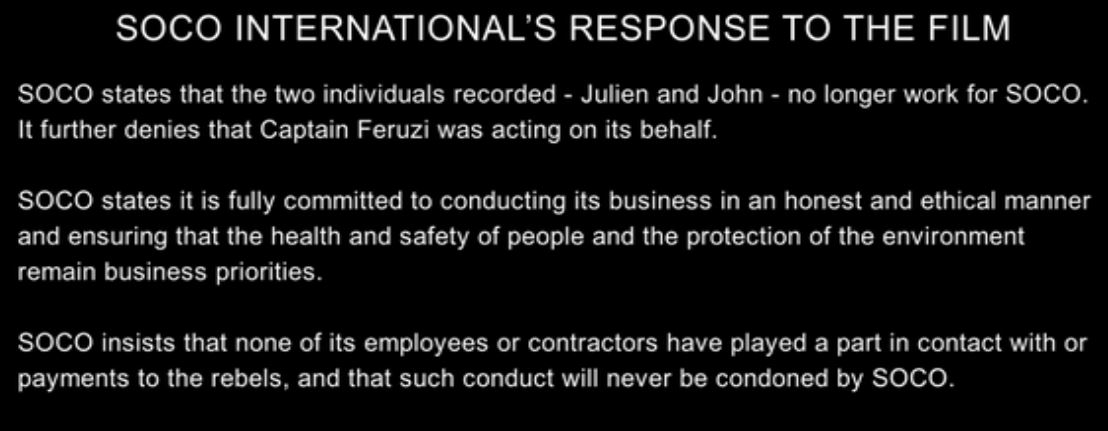
In response to the Virunga documentary SOCO International plc issued the following statements:
I wish that I could immediately do more to help Virunga National Park in the Democratic Republic of the Congo. I’m in the process of donating a small amount of money to the park but since I don’t use Paypal anymore it can’t be done immediately.
For now I’ve done my best (I hope) to present an objective review of the documentary and spread word of the film.
If anyone reading would like to make a donation directly to the Virunga National Park you may do so at the following link:
Please exercise your free speech in the comments section below. There are no stipulations of political correctness on this blog. Speak your mind, give us your thoughts, both objective and subjective. Share your ideas, hunches, inklings or your expertise. Please provide recommendation and corrections if you spot errors in fact within the blog report. Lastly, remember that posting a comment is much like casting a vote, so please do so.
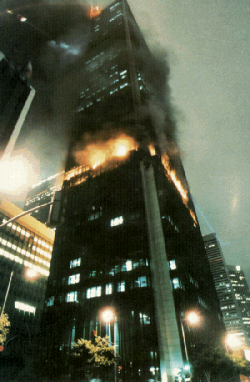
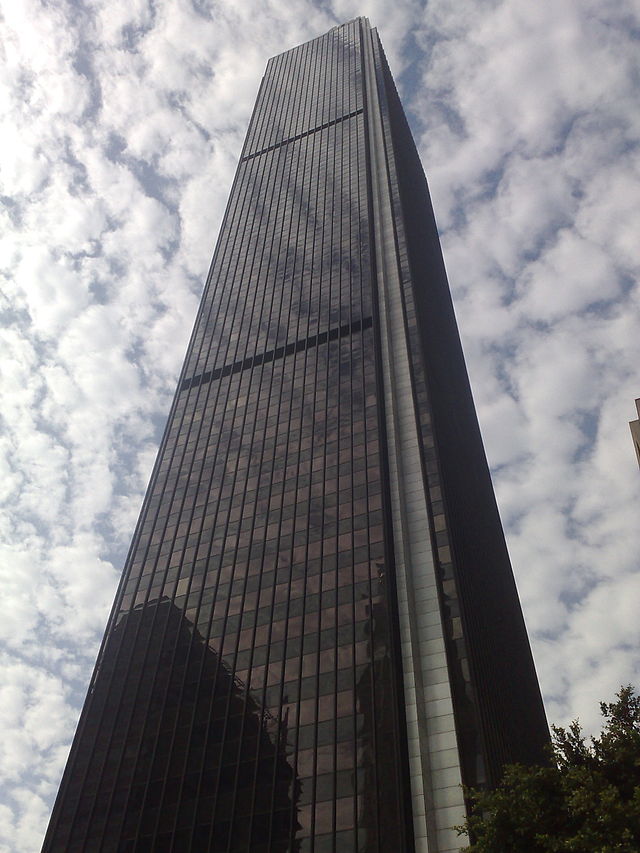
In May, 1988 the First Interstate Tower in Los Angeles, California burned for at least three (3) hours.
Construction of the 62-floor steel frame building was completed in 1973. The exterior was made of glass and aluminum.
At the time of the fire (1998) the building was not equipped with a working sprinkler system. A system was in process of being installed but inoperative at the time of the fire.
After the fire, the building remained closed for several months while the structure was inspected.
The property loss was estimated at over $200 million, without taking into account the business interruption loss.
In spite of the total burnout of four and a half floors, there was no damage to the main structural members and only minor damage to one secondary beam and a small number of floor pans. Although there was concern for structural integrity during the incident, post fire analysis indicates that there was no danger of major or minor structural collapse. It was noted that quality control in the application of the sprayed-on fire protection was unusually good.
Please exercise your free speech in the comments section below. There are no stipulations of political correctness on this blog. Speak your mind, give us your thoughts, both objective and subjective. Share your ideas, hunches, inklings or your expertise. Please provide recommendation and corrections if you spot errors in fact within the blog report. Lastly, remember that posting a comment is much like casting a vote, so please do so.
“It just seems to me that maybe if you open up our doors in a fair way and unleashed the spirit of peoples’ hard work, Detroit could become in really short order, one of the great American cities again. Now it would look different, it wouldn’t be Polish…But it would be just as powerful, just as exciting, just as dynamic.And that’s what immigration does and to be fearful of this, it just seems bizarre to me.“
Why do white Americans like Jeb Bush? Do we just vote for the guy because he’s white? Or is because contemporary white Americans are, in many ways, pea-brained? I think it’s probably a bit of both.
In Henry Ford’s day Detroit was a white American city with approximately 1/3 of those whites being first generation white European immigrants (they weren’t born in the USA).
Many Americans don’t know this but most of Henry Ford’s Five Dollar Day (8 hr day) employees were immigrants. Don’t believe me? Here’s a picture that we here at WOBIK took from page 38 of Fordlandia:
In 1914 journalist Julian Leonard Streetinspected Henry Ford’s plant in Highland Park and, among other things, wrote that the plant has a “savage looking foreign population.“
In 1915 Ford told journalist John Silas “Jack” Reed that he (Ford) didn’t believe in national boundaries that nations are silly and that flags are silly too. Ford said that he was going to pull down the American flag above his factory and replace it with a Flag of all Nations which he was designing. Don’t believe me? Here’s a picture that we here at WOBIK took from page 45 of Fordlandia:
Ford’s Five Dollar Day also attracted black Americans from the south.
When Detroit Mayor Coleman Young (Detroit’s first black American mayor) assumed office in January, 1974 Detroit’s population was approximately 50% black.
Coleman Young served as Detroit Mayor for thirty (30) full years, 1974 thru 1994.
Detroit became the biggest black city in America, a title which the city still holds today (2015).
It should also be noted that Coleman Young worked for the Ford Motor Company in the 1930’s.
Americans, both white and black, can say goodbye to Detroit if silly white Americans vote for Jeb Bush in 2016. If black Americans vote for Jeb Bush in 2016 I’ll call them silly too, but I don’t anticipate or envision any black Americans voting for him.
Please exercise your free speech in the comments section below. There are no stipulations of political correctness on this blog. Speak your mind, give us your thoughts, both objective and subjective. Share your ideas, hunches, inklings or your expertise. Please provide recommendation and corrections if you spot errors in fact within the blog report. Lastly, remember that posting a comment is much like casting a vote, so please do so.
Just a few months ago, back in September, 2014 most of us Birthers were objectively happy when Eric Holder announced that he would be resigning. Here at WOBIK we published (Sept. 24, 2014) a brief report regarding the resignation:
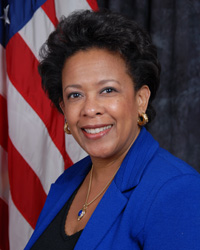
Barack Obama quickly struck back in November, 2014 with his nomination of Loretta Elizabeth Lynch for next US Attorney General.
Lynch currently serves as US Attorney for the Eastern District of New York. She assumed office in 2010 after being appointed by Barack Obama. It should be noted that she held the same office from 1999 thru 2001, after being appointed by Bill Clinton.
She was born in Greensboro, North Carolina in 1959 (she’s 55 now). She earned a Bachelor of Arts in English and American literature from Harvard College (1981) and a degree in law from Harvard Law School (1984).
From what I can gather black Americans, or at least the ones who are aware of who Lynch is and her recent nomination, appear to support her, exclusively, because she is black (or at least black by American standards). Moreover, white Americans who suffer from “white guilt conscience” appear to support Lynch, exclusively, because she is black.
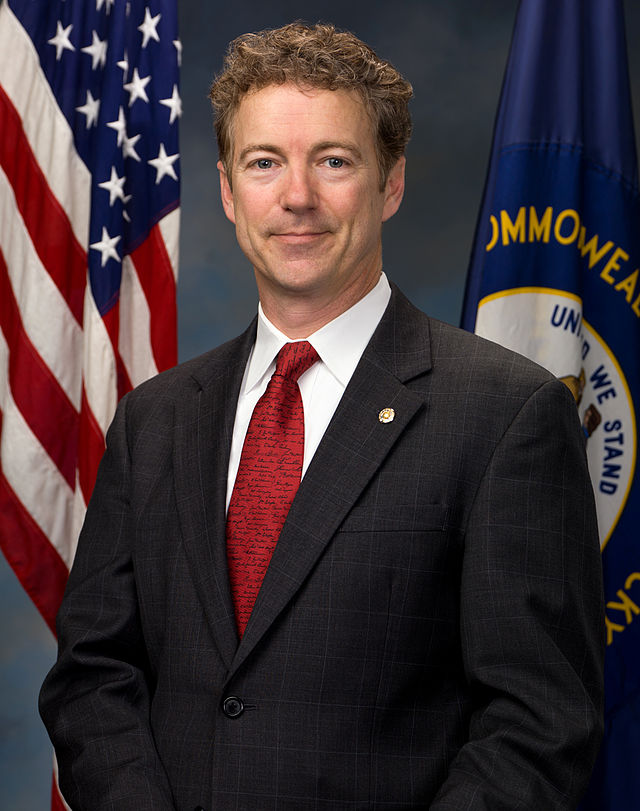
These findings became all the more apparent recently when US Senator Rand Paul (R-KY and possible 2016 candidate for POTUS) publicly opposed Lynch’s nomination.
The Senate Judiciary Committee confirmation hearing for Lynch began last week on January 28th (2015). Senator Charles E. Grassley (R-IA) is heading the committee.
At one point in the ongoing confirmation hearing Senator John Cornyn (R-TX), asked Lynch if she was going to be an Eric Holder version 2.0, “…you’re not Eric Holder, are you?” he said.
“No, I’m not,” Lynch said.
Lynch’s position is that she is an alternative to Eric Holder.
The CongressionalBlack Caucus (CBC) is now condemning US Senator Rand Paul (R-KY and possible 2016 candidate for POTUS) and expressing extensive disapproval because Paul opposes Lynch’s nomination.
Senator Paul has commendably stood up for black Americans for as along as I can remember and he continues to do so now by opposing Lynch’s confirmation.
Loretta Lynch is an advocate and proponent of Civil Forfeiture.
A few months ago, November 22 (2014) the Wall Street Journal published an editorial titled, Loretta Lynch’s Money Pot.
According to the Wall Street Journal there have been at least 120 cases in which Loretta Lynch has used civil asset forfeiture to expropriate approximately $113 million for federal and local coffers.
One of the problems with civil forfeiture is that you don’t have do be found guilty of anything before your property, cash and assets can be seized by the government. Many victims of civil forfeiture are not connect to crimes at all. Forbes Magazine recently published (Sept. 12, 2014) an article (by George Leef) regarding the perils of civil forfeiture which contains extensively alarming examples: Time For Civil Asset Forfeiture Laws To Meet The Same Fate As Jim Crow
Civil asset forfeiture is one the most flagrant examples of government overreach. Money, property, or other possessions without a conviction. Reader may not be aware of this but criminal charges are not even prerequisites for seizing assets.
The US Department of Justice (DOJ) expropriated approximately two (2) billion dollars in 2013 (financial year) through civil forfeiture.
Last week during Lynch’s ongoing confirmation hearing she stated the following regarding civil forfeiture, “I believe that civil and criminal forfeiture are important tools to the Department of Justice, as well as our state and local counterparts through state laws, in essentially managing or taking care of the first order of business, which it to take the profit out of criminal activity.”
In an recent interview with Breitbart News, Senator Rand Paul stated the following regarding Loretta Lynch, I’m concerned that a big part of her fame as a federal prosecutor was through civil forfeiture. She was asked specifically about this by Sen. Lee, and her response was ‘oh, everything is fine, it’s done with a court order.’ She seems to not quite understand that innocent people are having their stuff taken by government–their cars, their money, their hotels, their stuff is being confiscated by government even if they’re never charged or even if they’re never convicted. She didn’t seem to grasp that point and this is a week after parts of the administration said they were not going to enforce some of the civil forfeiture:
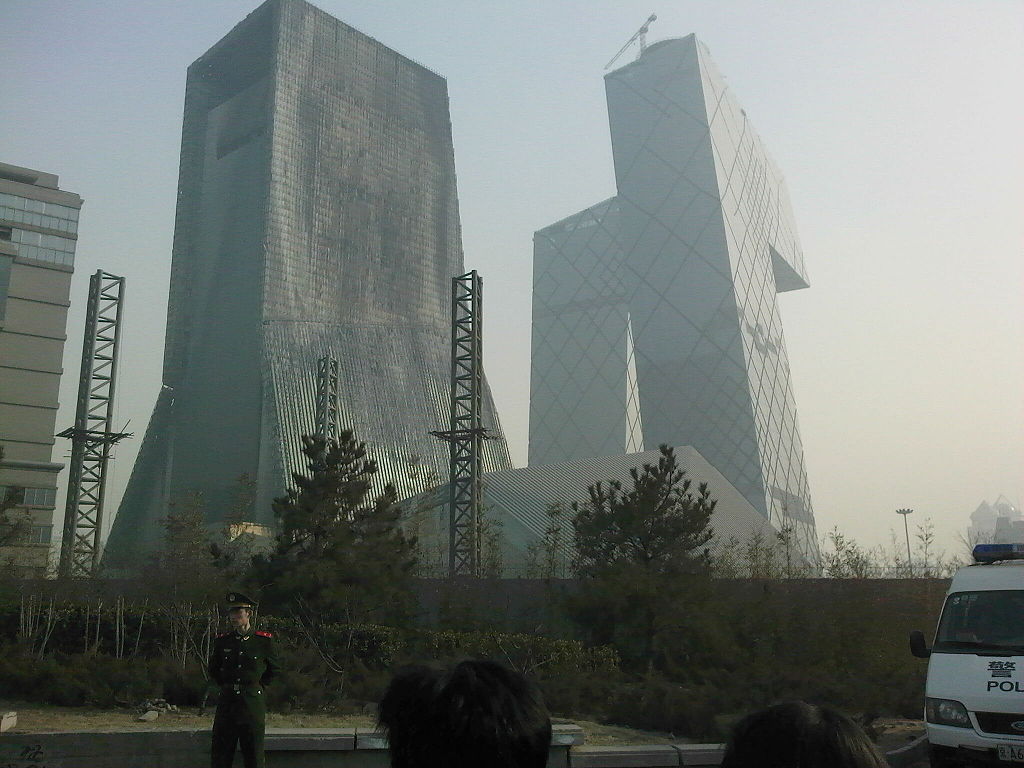
In February, 2009 the Beijing Television Cultural Center – TVCC (main tenant was Mandarin Oriental Hotel) burned for six (6) hours after being accidentally set on fire by staff in the adjacent CCTV (China Central Television) building who were setting off fireworks for the Yuanxiao holiday.
The Yuanxiao holiday is also known in English as the Lantern Festival. The festival is celebrated on the fifteenth day of the first month in the Lunisolar year in the lunar calendar marking the last day of the lunar New Year celebration.
You can view the immense fireworks display, which lead t0 the fire, in the video below:
Here’s a picture of the building before the fire:
Here’s a picture of the building after the fire:
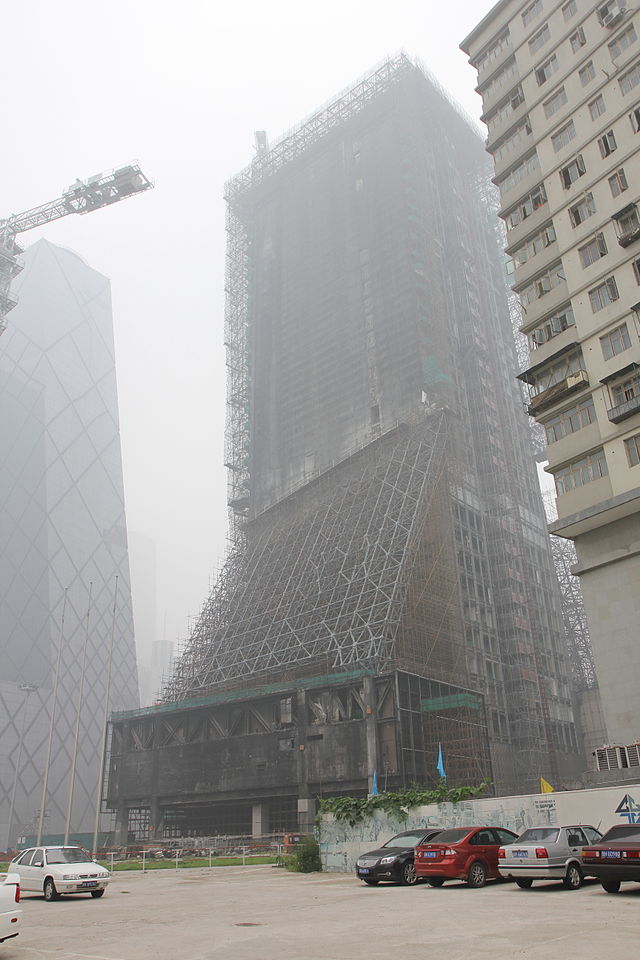
Here’s the building being rebuilt in 2011, with the same steel that burned for six (6) hours:
The initial images of the blaze suggested that the tower might be nearly destroyed. However, Rem Koolhaas said that, “they are simply rebuilding it as it was, because there was no structural damage.”
Remment Lucas “Rem” Koolhaas is a Dutch architect, architectural theorist, urbanist and Professor in Practice of Architecture and Urban Design at the Graduate School of Design at Harvard University.
World Trade Center, September 11, 2001:
South Tower: collapsed at 9:59 a.m. after burning for approximately 56 minutes.
North Tower: collapsed at 10:28 a.m. after burning for approximately 102 minutes.
Source –NIST NCSTAR 1-1 (2005), p. 34; pp. 45–46
World Trade Center 7 (47-floor steel building): endured fire for almost seven hours,10:28:22 a.m. until 5:20:52 p.m., and then collapsed.
Please exercise your free speech in the comments section below. There are no stipulations of political correctness on this blog. Speak your mind, give us your thoughts, both objective and subjective. Share your ideas, hunches, inklings or your expertise. Please provide recommendation and corrections if you spot errors in fact within the blog report. Lastly, remember that posting a comment is much like casting a vote, so please do so.
Please exercise your free speech in the comments section below. There are no stipulations of political correctness on this blog. Speak your mind, give us your thoughts, both objective and subjective. Share your ideas, hunches, inklings or your expertise. Please provide recommendation and corrections if you spot errors in fact within the blog report. Lastly, remember that posting a comment is much like casting a vote, so please do so.
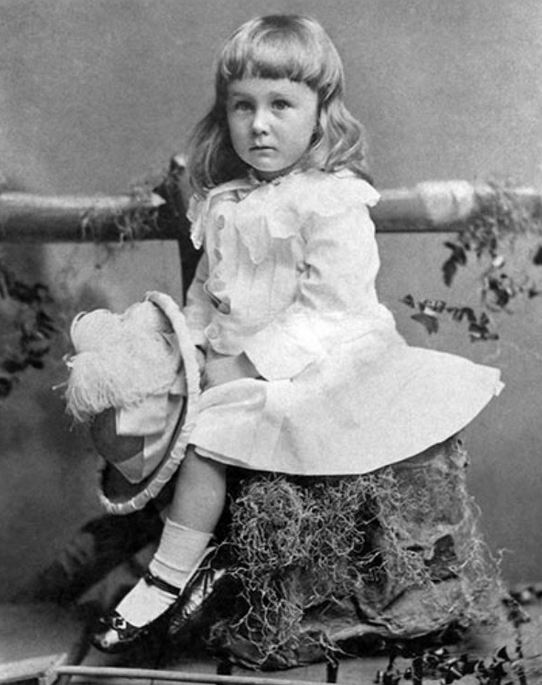
Future US President Franklin Delano Roosevelt, 1884:
Please exercise your free speech in the comments section below. There are no stipulations of political correctness on this blog. Speak your mind, give us your thoughts, both objective and subjective. Share your ideas, hunches, inklings or your expertise. Please provide recommendation and corrections if you spot errors in fact within the blog report. Lastly, remember that posting a comment is much like casting a vote, so please do so.
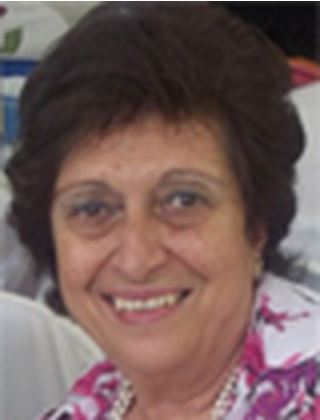
That’s Teddy Gianopulos in the adjacent photograph. She worked for the United Nations Environment Programme (UNEF) for approximately forty (40) years.
According to the official UNEF website (http://www.unep.org/) she met doctor James Ang’awa (Obama’s birth doctor) on December 5th, 1964 in Kenya:
Before joining UNEP in 1979 – I had worked for a number of UN Agencies in both Kenya and Ethiopia – but the powerful flashback that is permanently in my mind is the day that I graduated from College. It was the afternoon of Friday, December 5th 1964 – Prize Giving Day – which instantaneously changed the course of my life. My plans for going into Medicine and eventually specializing in Pediatrics were put on hold (or so I thought) as I was intrigued and fascinated by the work of the UN – especially that of UNICEF and WHO, who were providing Emergency funds for children and working on Tuberculosis. Fate was moving its huge hand and I felt an inner power of spontaneity that was guiding my every move. In those days, I was a rather shy youngster and certainly not the forthcoming extrovert that I turned into in later years!
At the prize giving, diplomas were being handed out by a very polite and soft-spoken man, the WHO Representative, Dr. James Ang’awa. When it came to my turn, I looked up into a gentle face when he asked what my future plans were? I didn’t hesitate with my response of very much wanting to work for the United Nations – especially WHO and UNICEF. In a flash, I saw a sad look cross his eyes when he told me that it was a shame that I didn’t have any experience as he had a vacancy in his office. He required the services of an able assistant to work together with a large number of doctors and experts in the research of Tuberculosis.
I lost my breath – but just for a split second – before I blurted out a rather impulsive and probably a cheeky request. “May, I please make a suggestion?” I asked, my heart thumping in my chest. “I will work for you, free of charge for a month and if I don’t prove suitable, there will be no hard feelings on either side.” I felt I was going to faint when he shook his head in agreement and very calmly said, “You can start on Monday!”
She then met Bruce Steadman!
That was the start of my 40 years of service in the UN! As luck would have it, I was offered a contract with UNICEF, in Ethiopia, two months later. I knew that a career with the UN was my destiny and I was to embrace every opportunity that was given to me.
When UNEP inaugurated its offices at the Kenyatta Conference Centre – before the move to Gigiri – Bruce Steadman, Deputy to UNEP’s first Executive Director, Maurice Strong, asked me to join him, as his Personal Assistant when he moved from Addis Ababa to join UNEP. Family obligations and having to care for a year-old baby, sadly forced me to turn the offer down. But, 2 years later, in February 1979, I joined UNEP to work with Peter Thacher, Deputy to Dr. Mostafa Tolba. I felt that the most valuable experience that I carried with me, at the time, was how to work in grueling circumstances having just survived one of the cruelest revolutions to take place on African soil. Our UNDP offices were bombed, colleagues were imprisoned, close friends lost loved ones while some even fatally collapsed in front of our eyes. That horrible experience helped me develop – in a weird sort of way – a sense of calmness and level-headedness in dealing with crisis. As luck would have it, this was put to test, in a much milder way, during the attempted coup in Kenya in 1981!
I don’t think that this Bruce Steadman is our Bruce Steadman from here at WOBIK but we absolutely had to make a record of this strangeness!
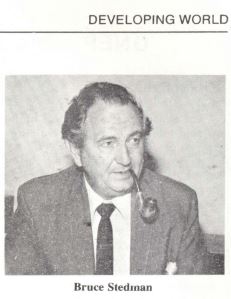
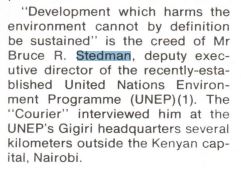
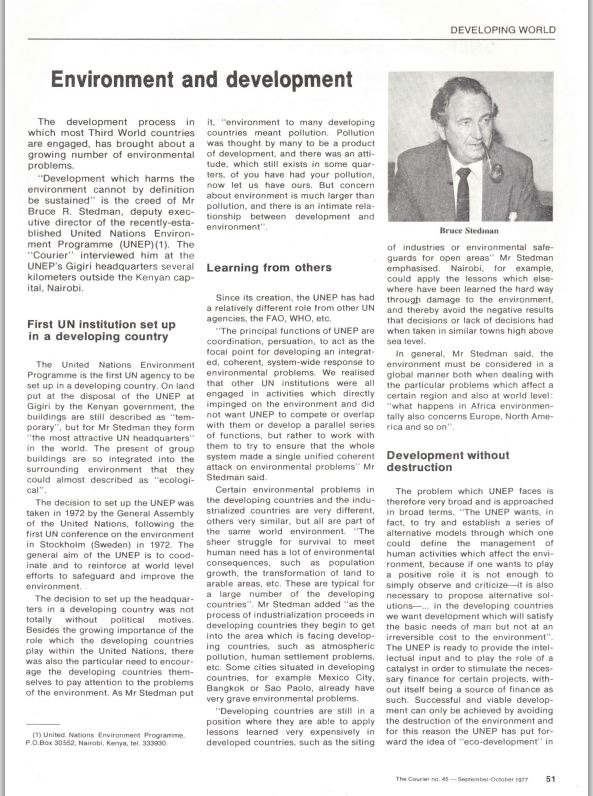
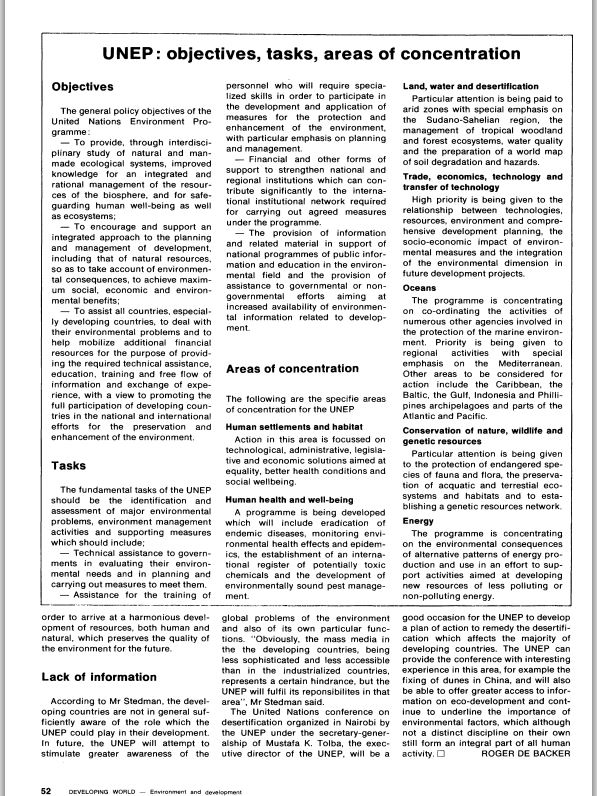
We also found a picture (adjacent left) of UNEF’s BruceStedman, and a full page article regarding Deputy Executive Director Bruce Stedman, in a tangible publication called The Courier: European Community – Africa-Caribbean-Pacific (No. 45), September – October 1977.
Bruce was interviewed by The Courier at the Gigiri headquarters of the United Nations Environment Programme which was located several kilometers outside of Nairobi, Kenya.
As you may have noted by now The Courier spells his last name as Stedman as opposed Steadman which is listed at the United Nations Environment Programme’s officialwebsite.
Which spelling is correct? Is this another example of doctor Helton Maganga vs Heltan Maganga?
From what we’ve been able to gather today we believe that the official UNEP.org website has the incorrect spelling (if there is such a thing) their ex-Deputy Executive Director. We believe that he probably spelled his name as Stedman.
Having said that, is it really so difficult to believe that Coast Province General Hospital in Kenya used the Helton spelling for doctor Maganga?
Directly below is The Courier full two page (pp. 51-52) article on Bruce Stedman writen by Roger de Backer:
Below please find an embedded PDF of the complete volume No. 45 of The Courier (78 pages):
Please exercise your free speech in the comments section below. There are no stipulations of political correctness on this blog. Speak your mind, give us your thoughts, both objective and subjective. Share your ideas, hunches, inklings or your expertise. Please provide recommendation and corrections if you spot errors in fact within the blog report. Lastly, remember that posting a comment is much like casting a vote, so please do so.
Ethan Williams on What is a “Minor-attracted person” (MAP)?: “Yeah, Biden is no doubt a disgusting “MAP”. What do you think about the controversy around “Miss Shirley”? Adult men…” Jun 8, 23:19











![Fordlandia_38[1]](http://www.wasobamaborninkenya.com/blog/wp-content/uploads/2015/02/Fordlandia_381.jpg)
![45_Fordlandia[1]](http://www.wasobamaborninkenya.com/blog/wp-content/uploads/2015/02/45_Fordlandia1.jpg)